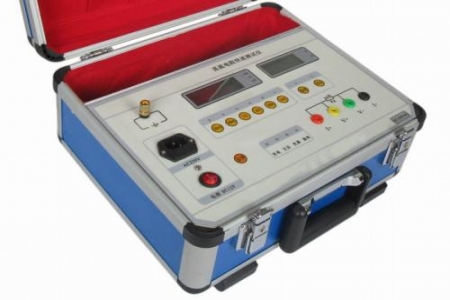
High-Voltage Wireless Phase Detectors Are Used in Power Systems to Detect Whether Two Lines
Key safety tool for determining whether the phase relationship between two transformers or two busbar sections is consistent (i.e., same phase or different phase).
Phase detection must be performed before grid loop closing operations, new equipment commissioning, or after line maintenance. If phases are incorrect (e.g., phase A connected to phase B) and the switch is closed directly, it will cause a severe phase-to-phase short circuit, leading to explosion and equipment damage. Wireless phase detectors have become mainstream equipment in modern power O&M due to their cable-free operation, long operating distance, and high safety.
Combined with the latest technical trends from 2025-2026, the following is a detailed analysis:
1. Core Working Principle
Signal Acquisition: Two independent detectors (transmitters) at the top of insulated rods contact or approach high-voltage live parts respectively to sense voltage signals.
Wireless Transmission: The detectors transmit collected data such as phase, frequency, and voltage amplitude in real time to the handheld receiver host via dedicated radio frequency (RF) or Bluetooth/4G/5G modules.
Intelligent Comparison: The host receives two signals and automatically calculates the phase difference.
Same Phase: Phase difference close to 0° (typically <30°), voice announces same phase, screen displays green.
Different Phase: Phase difference close to 120° or 240°, voice announces different phase, screen displays red with alarm.
Self-Test Function: Modern instruments feature automatic self-test functionality, verifying communication and synchronization between the two detectors upon startup to ensure measurement reliability.
2. 2025-2026 Mainstream Technical Features
The new generation of wireless phase detectors has significant improvements in voltage level coverage, anti-interference capability, and intelligence:
Table
Technical Dimension Typical Specifications and Highlights (2026 Model) Description
Voltage Level 0.22kV - 1000kV (Full Coverage) A single set of equipment can meet all scenarios from low-voltage distribution networks to UHV transmission, with automatic voltage level identification.
Transmission Distance ≥ 150m - 300m Uses encrypted frequency hopping technology for more stable transmission in complex substation environments without blind spots.
Measurement Mode Contact + Non-Contact Can directly contact bare conductors or measure insulated cables and enclosed busbars through induction (without stripping).
Display and Interaction 5-7 inch high-definition color screen
Vector Diagram Dynamic Display Real-time drawing of vector diagrams and waveform diagrams for two voltage signals, visually displaying phase relationships; supports voice announcement (Chinese/English).
Additional Functions Voltage Detection + Frequency Measurement + Phase Sequence Detection Multi-purpose: first verify voltage presence, then measure frequency (50Hz/60Hz), finally phase detection, also capable of determining phase sequence.
Safety Dual-Channel Independent Insulation
IP67 Protection Complete electrical isolation between detector and host; waterproof and dustproof, suitable for rain and snow adverse weather.
Data Management Bluetooth/USB Export
GPS Positioning Test data automatically stored, can generate phase detection reports with time and GPS location, supporting upload to inspection systems.
Battery Life Large-Capacity Lithium Battery Continuous operation time > 10 hours, supports fast charging.
3. Representative Models and Manufacturers (2026 Reference)
A. High-End All-Round Type (UHV/Complex Environments)
Wuhan Moen (MOEORW) - MEWX-1000
Features: Supports 1000kV UHV, transmission distance up to 300 meters, with extremely strong anti-electromagnetic interference capability, built-in high-precision clock and GPS, suitable for large hub substations.
Wuhan Huatian Electric Power - HTWX-900
Features: Color vector diagram display, supports hook-type non-contact measurement, particularly suitable for insulated cables and switchgear internal phase detection without de-energizing or opening cabinet doors (within safe distance).
B. Standard Portable Type (Conventional Transmission and Distribution)
Yangzhou Haiwo Electric - HWWX-300
Features: High cost-effectiveness, easy operation, clear voice prompts, covering 10kV-500kV, standard configuration for municipal power supply company crews.
Guodian Xigao - GDWX-200
Features: Lightweight and compact, strong integrated design of host and detector, suitable for rapid operation on 10kV-35kV distribution network lines.
Shanghai SUTE - STWX-II
Features: Supports mobile app connection, real-time data synchronization to mobile phone, convenient for on-site photo archiving and remote expert guidance.
4. Purchase Recommendations
Voltage Level Requirements:
For 10kV-35kV distribution networks only, choose a basic model (transmission distance about 100 meters), focusing on portability.
For 110kV-500kV and above, must choose a high-end model, focusing on insulating rod length (must comply with safety regulations) and anti-interference capability.
Measurement mode:
If frequent phase detection of insulated cables or fully enclosed switchgear is needed, be sure to select a model supporting non-contact (inductive) measurement.
Environmental Adaptability:
In rainy, dusty, or strong electromagnetic interference areas (such as near converter stations), confirm the instrument protection rating (IP67) and immunity indicators.
Compliance:
Must comply with DL/T 971-2017 and GB/T 18216 and other relevant standards.
Insulating rods must pass preventive testing regularly (typically once a year).
5. Market Price Reference
Basic Type (10kV-35kV, digital/simple LCD): Approx. 2,000 - 4,000 RMB.
Standard Type (10kV-220kV, color screen, voice, vector diagram): Approx. 5,000 - 9,000 RMB.
High-End Type (500kV-1000kV, long distance, strong anti-interference, GPS/APP): Approx. 12,000 - 25,000 RMB.
6. Operating Precautions (Safety First!)
Insulation Inspection: Before use, check whether the insulating rod surface is clean, dry, and crack-free, and confirm it is within the valid test period.
Self-Test Procedure: After startup, first contact both detectors with the same known power source (or short-circuit the self-test line) and confirm the display shows same phase before formal use. Never skip self-test!
Safety Distance: Operators must wear full insulating protective gear (insulating gloves, insulating boots) and maintain the minimum safe distance from live parts (based on voltage level, e.g., 10kV ≥ 0.7m, 110kV ≥ 1.5m).
Error Prevention: In strong electric field interference, if readings are unstable, try changing the detector angle or position, or switch to contact measurement if conditions permit.
Two-Person Operation: Phase detection work typically requires two people, one operating and one supervising.
If you need to know the safety distance standards for specific voltage levels, or need specific wiring/operation videos for a particular instrument, please feel free to let me know!