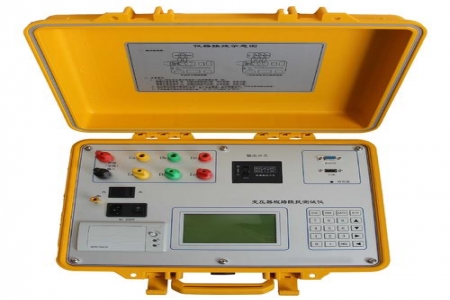


Introduction to Loop Resistance Tester
The Loop Resistance Tester is a professional device specifically designed for measuring contact resistance or conductive loop resistance between two points in electrical systems. These instruments are widely used in power systems, industrial manufacturing, maintenance and repair, and are especially suitable for measuring contact resistance at critical points such as high-voltage circuit breakers, disconnectors, and busbar connections. By using a Loop Resistance Tester, the quality of electrical connections can be effectively evaluated, potential safety hazards can be identified, and the safe and stable operation of the system can be ensured.
Main Applications
Circuit Breaker and Switchgear Detection: Used to measure contact resistance between high-voltage circuit breaker and disconnecting switch contacts to ensure they can operate normally under high current loads.
Busbar and Cable Joint Testing: Check resistance values at busbar connection points and cable joints to identify high-resistance connections caused by corrosion, loosening, etc., preventing overheating faults.
Other Electrical Connection Testing: Applicable to various scenarios requiring precise resistance measurement, such as transformer winding connections and grounding systems.
Working Principle
The Loop Resistance Tester typically operates based on the four-terminal method (Kelvin connection), which effectively eliminates the influence of lead resistance on measurement results. During testing, the instrument applies a constant DC current (typically ranging from 10A to several hundred amperes) to the circuit under test, and measures the voltage drop across the resistance through a separate pair of voltage detection leads. According to Ohm's Law
Features and Functions
High Current Output: To simulate current loads under actual working conditions, many Loop Resistance Testers can provide high current output up to several hundred amperes, ensuring the authenticity and reliability of test results.
High Precision Measurement: Provides micro-ohm level or even lower resolution, ensuring measurement accuracy, which is crucial for detecting subtle resistance variations.
Automatic Temperature Compensation: Considering the effect of temperature on resistance values, some advanced models are equipped with temperature compensation functions that provide corrected resistance values at different ambient temperatures.
Data Storage and Transmission: Supports storage of measurement data and can transfer data to a computer via USB, Bluetooth, and other interfaces for further analysis, facilitating subsequent data processing and report generation.
Development Trends
With technological development, loop resistance testers are becoming more intelligent and portable:
User Interface Optimization: Modern devices often feature touchscreen interfaces, making operation more intuitive and convenient while reducing learning costs.
Application of Wireless Communication Technology: Makes data processing and sharing easier, improving work efficiency while also supporting remote monitoring and data analysis.
Improving Test Speed and Accuracy: Manufacturers continuously explore how to shorten testing time while ensuring measurement accuracy to better adapt to on-site testing needs.
In summary, the loop resistance tester is an important tool for ensuring the safe and stable operation of electrical systems. Whether for quality control of new equipment or maintenance inspection of old equipment, it plays an irreplaceable role. With technological advancement, these testers will continue to evolve, providing more efficient and precise solutions to meet increasingly diverse application needs.