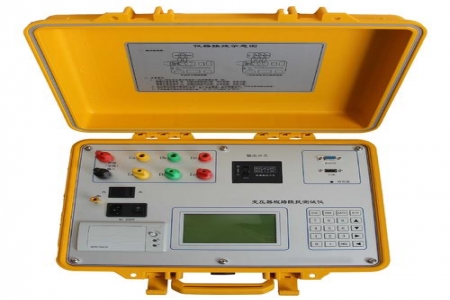


Loop Resistance Tester: A Key Tool for Ensuring Contact Reliability in Power Systems
To help you write an article about Loop Resistance Testers, below is a detailed outline that you can use to organize your article content.
Title
Loop Resistance Tester: A Key Tool for Ensuring Contact Reliability in Power Systems
Introduction
Background Introduction: Briefly introduce the application background of the Loop Resistance Tester and its importance in power systems.
Importance: Emphasize the role of the Loop Resistance Tester in power system testing, especially regarding improving testing efficiency and reliability.
Loop Resistance Tester Basics
Definition: Explain the concept of the Loop Resistance Tester and its applications in power systems.
Components: Introduce the main components of the Loop Resistance Tester, including current source, preamplifier, A/D converter, and display device.
Working Principle: Elaborate on the working principle of the Loop Resistance Tester, namely using the current-voltage method (also known as the four-wire method), which applies a known DC current and measures the voltage drop across both ends to calculate the loop resistance value.
Technical Specifications and Performance Indicators
Test Range: List the resistance range that the Loop Resistance Tester can handle.
Accuracy: The precision of detection and measurement provided by the testing device.
Portability: The portability level of modern Loop Resistance Testers and features suitable for on-site use.
Test Current: The typical test current magnitude used, such as 100A.
Usage Methods and Operating Guide
Installation Preparation: Describe how to install the Loop Resistance Tester and prepare connections to the equipment under test.
Parameter Setting: Detail how to set test parameters such as test current.
Operating Steps:
Attach the test clips to both ends of the device under test, ensuring good contact.
Press the test button and observe the display screen; typically wait a certain time before reading the displayed resistance value.
Data Reading and Recording: Explain how to read test data and record it.
Precautions and Maintenance
Safety Notices: Emphasize safety matters that need attention when using the Loop Resistance Tester.
Maintenance: Provide daily maintenance suggestions, such as regular calibration and keeping the equipment clean.
Troubleshooting: Provide some common problems and their solutions.
Application Cases
Switchgear Contact Resistance Testing: Specifically introduce how to use the Loop Resistance Tester for switchgear contact resistance testing.
Cable Line DC Resistance Testing: Describe the application of the Loop Resistance Tester in cable line DC resistance testing.
Ultra-Low Resistance Non-Inductive Device Resistance Testing: Provide several practical application scenario examples demonstrating the performance of the Loop Resistance Tester in ultra-low resistance non-inductive device resistance testing.
Technical Advantages and Limitations
Advantages: Discuss the benefits brought by the Loop Resistance Tester, such as improving testing efficiency, reducing energy consumption, and decreasing equipment size and weight.
Limitations: Point out possible limiting factors, such as cost and applicability in specific environments.
Future Development Trends
Technological Innovation: Look ahead to possible technological advances, such as more efficient signal processing technology and intelligent operation.
Market Prospects: Mention the future development potential and trends of the Loop Resistance Tester market.
Conclusion
Summary: Review the importance and application prospects of the Loop Resistance Tester.
Call to Action: Encourage the power industry to adopt advanced Loop Resistance Tester technology to improve the safety and reliability of power systems.
References
Technical Manuals: List technical manuals provided by manufacturers.
Academic Research: List relevant academic papers and research reports.
Industry Reports: Provide links to authoritative reports from the power industry.
Through the above structure, you can write a comprehensive article introducing Loop Resistance Testers. Remember to incorporate the latest research results and technological advances when writing to ensure the content is accurate and timely. If you need more specific information or technical details, feel free to ask at any time.