When the low-voltage side current exceeds the rated current, shutdown protection will be activated.
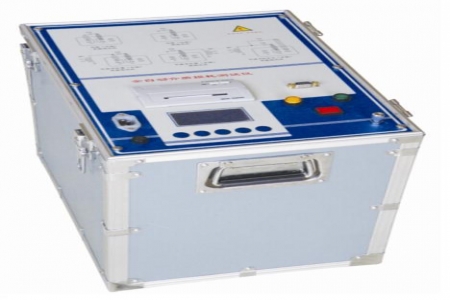
Featuring microcomputer control with automatic voltage boost, reduction, and discharge, photoelectric control outputs 0.1Hz sine waves, with manual intervention possible during automatic boost. Fully electronic design ensures compact size and light weight. Large LCD display is clear and intuitive, capable of showing output waveforms with printout function. Design specifications fully comply with the power industry standard "General Technical Conditions for Special Test Instruments for Power Equipment, Part 4: General Technical Conditions for VLF High-Voltage Generators," making it very convenient to use. Currently, mechanical modulation and demodulation methods used both domestically and internationally result in non-standard sine wave waveforms, large measurement errors, spark discharge in the high-voltage section, bulky equipment, and the sine wave second and fourth quadrants requiring high-power high-voltage resistors for discharge shaping, resulting in high overall power consumption. This product overcomes all these shortcomings, and additional protection functions are designed as follows:
font-size:="" microsoft="" Over-Voltage Protection: When exceeding 10% (or 1.1 times) of the set test voltage value, the instrument will shut down for protection, with an action time of less than 20 milliseconds.
font-size:="" microsoft="" Over-Current Protection: Designed with dual high-low voltage protection; the high-voltage side can perform precise shutdown protection according to set values; when the low-voltage side current exceeds the rated current, shutdown protection is activated, with action times of less than 20 milliseconds.
font-size:="" microsoft="" Working Principle:
font-size:="" microsoft="" Such large equipment is not only bulky, expensive, and inconvenient to use. To resolve this contradiction, the test frequency was reduced, thereby lowering the test power supply capacity. Years of domestic and international theory and practice have proven that 0.1Hz VLF withstand voltage testing can replace power frequency withstand voltage testing with equivalent effectiveness while significantly reducing equipment volume and weight — capacity is approximately 1/500th of power frequency, test procedures are greatly simplified, offering more advantages over power frequency testing, which is why developed countries universally adopt this method. China's Ministry of Electric Power has commissioned the Wuhan High Voltage Research Institute to draft the industry standard "VLF (0.1Hz) Withstand Voltage Test Method for XLPE Insulated Power Cables at 35kV and Below," and China is promoting this method. This instrument was developed according to this national need. It can be widely used for AC withstand voltage testing of cables, large high-voltage rotating machines, and power capacitors.
font-size:="" microsoft="" Main Features:
font-size:="" microsoft="" Featuring power supply over-current, high-voltage over-current, and protection functions, with high-voltage startup disabled until the output regulator returns to zero, this is a next-generation replacement for traditional power frequency withstand voltage test equipment. The VLF AC withstand voltage device primarily uses sine waves or cosine square waves as output sources — a new type of VLF AC testing device mainly used by power utilities for non-destructive insulation withstand testing of PE (polyethylene)/XLPE (cross-linked polyethylene) plastic power cables, representing international advanced level from the late 20th century and domestic leading level.