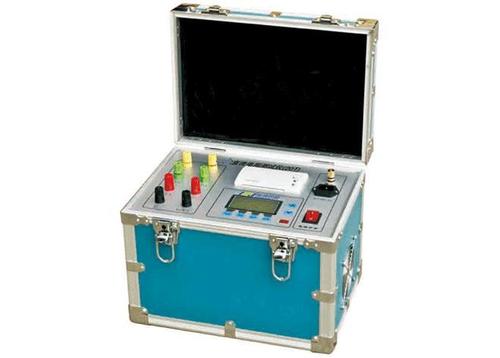
The Loop Resistance Tester (Also Called Contact Resistance Tester) Is Used in Power Systems for Measuring High-Voltage Switchgear Such as Circuit Breakers, Disconnecting Switches, and GIS Combination Devices
A specialized instrument for measuring the resistance of conductive loops. Its core purpose is to detect whether contacts are in good condition, preventing heating, burnout, and even grid accidents caused by excessive contact resistance. Based on the latest industry developments, technical standards, and brand reviews from 2025-2026, here is a detailed guide on loop resistance testers: 1. Core Working Principle and Technical Standards Measurement Principle: Uses the four-terminal method (Kelvin bridge method), where current terminals (C1, C2) and voltage terminals (P1, P2) are separated, effectively eliminating the influence of test lead resistance and contact resistance to ensure micro-ohm (μΩ) measurement accuracy. Output Current: According to national standards DL/T 474.4 and GB 50150, the test current typically needs to reach 100A DC or above to break through the oxide film on contact surfaces and simulate actual operating conditions. High-end models support 200A, 300A, or even higher currents. Key Indicators: Resolution: Up to 0.01μΩ, capable of capturing minute resistance changes. Stability: In strong electromagnetic interference environments (such as substation sites), current ripple must be minimal with stable readings. Speed: New-generation intelligent instruments can complete current ramp-up, measurement, data processing, and printing within 30 seconds. 2. 2025-2026 Market Trends: Intelligence and Domestic Substitution The market is currently transitioning from "simple measurement" to "intelligent diagnosis," with main trends including: Intelligent Integration: Built-in large-capacity storage supporting historical data tracing, curve analysis, Bluetooth/WIFI wireless transmission, and direct generation of test reports compliant with State Grid/Southern Power Grid standards. Enhanced Anti-Interference: For UHV environments and complex electromagnetic fields, high-frequency inverter technology and digital filtering algorithms significantly improve measurement stability. Rise of Domestic High-End Products: Previously, the high-end market was monopolized by imported brands, but 2025 evaluations show that domestic brands represented by Wuhan UHV and Jiangsu Jiuyi have fully matched or even surpassed some imported products in accuracy, stability, and functionality, with better cost-effectiveness and service response speed. 3. Mainstream Brand Recommendations (2026 Edition) Based on the latest rankings from CNPP, MAIGOO, and industry professional media, the market landscape is divided into "international top-tier" and "domestic leading" camps: A. International Top-Tier Brands (suitable for foreign-related or high-end projects with brand premium requirements and sufficient budgets) Megger: British brand, the "gold standard" in power testing, renowned for extremely high stability and durability, but expensive with longer lead times. Fluke: American brand, strong versatility and easy operation, but Megger is more specialized in ultra-high current (>100A) dedicated loop testing. HIOKI / KIKUSUI: Japanese brands, high precision and fine workmanship, suitable for laboratories and precision manufacturing. B. Domestic Leading Brands (preferred for power O&M, cost-effective, fast service) Wuhan UHV Power Technology Co., Ltd.: Features: The "dark horse" and leader in 2025 industry evaluations. Their equipment uses high-frequency inverter technology, supports 100A-300A high current, has extremely strong anti-interference capability, and is widely used in State Grid and Southern Power Grid technical renovation projects. Advantages: Designed specifically for domestic complex working conditions, software systems comply with domestic reporting standards, and after-sales response is extremely fast. Jiangsu Jiuyi Electric Equipment Co., Ltd.: Features: Focused on intelligent power testing equipment, with outstanding product portability and intelligent data management. Shanghai Shenggao Electric / Yangzhou Tuopu: Features: High market share in East China, rich product lines covering the full range from basic to high-end intelligent models. Other Notable Brands: UNI-T, VICTOR, etc. also perform well in general low-resistance measurement, but professional power manufacturers (such as the aforementioned Wuhan and Jiangsu enterprises) are more specialized in hundred-ampere-level high-current loop testing. 4. Selection Recommendations When purchasing a loop resistance tester, focus on the following parameters: Test Current: Must be ≥100A DC. For large generator outlet circuit breakers or GIS equipment, 200A or 300A models are recommended. Range and Resolution: Range should cover 0-2000μΩ (or wider), resolution at least 0.1μΩ, preferably 0.01μΩ. Protection Functions: Must have back EMF protection, overheat protection, and overcurrent protection to prevent instrument damage when testing inductive loads or during misoperation. Data Management: Whether USB export, Bluetooth printing, built-in calendar clock, and power-loss data preservation are supported. Qualification Certification: Must pass verification by provincial-level or higher metrology institutes and comply with DL/T 474.4 standards. 5. Operating Precautions Wiring Sequence: Connect current leads first, then voltage leads; reverse when removing. Ensure clamps make good contact with test points and remove oxidation layers. Discharge: After testing, the instrument will automatically discharge, but always wait for the discharge indicator to finish before disconnecting wires to prevent residual charge injury. Environment: Avoid testing during thunderstorms or in areas with unshielded strong magnetic fields.