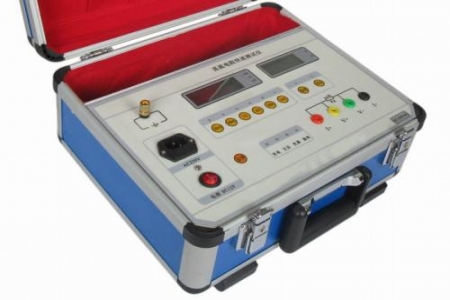

The Transformer DC Resistance Tester Is a Specialized Instrument for Measuring Transformer DC Resistance
The Transformer DC Resistance Tester is a precision instrument specifically designed for measuring the DC resistance of transformer windings. This type of tester plays a crucial role in the maintenance and repair of power systems, as it helps technicians assess the health condition of transformer windings, thereby ensuring the safe and stable operation of power systems. Below is an article overview about Transformer DC Resistance Testers:
I. Introduction
Introduce the importance of the Transformer DC Resistance Tester and its application background in power systems.
Briefly describe its significance for power facility maintenance and safe operation.
II. Basic Concepts
Definition: Explain what a Transformer DC Resistance Tester is.
Function: Describe its main purpose, namely measuring the DC resistance of transformer windings.
Importance: Explain its role in power system maintenance, especially in accident prevention.
III. Technical Principles
Working Principle: Briefly explain the working principle of the Transformer DC Resistance Tester, including the basic process of current injection and voltage measurement.
Key Technologies: Introduce the key technologies used in the device, such as constant current sources and high-precision ADCs (Analog-to-Digital Converters).
Testing Methods: Explain commonly used testing methods, such as the four-terminal method (Kelvin connection).
IV. Product Features
Measurement Range: Introduce the measurement range of the device, including minimum and maximum resistance values.
Accuracy and Resolution: Emphasize the measurement accuracy and resolution of the device, and how to ensure the accuracy of test results.
Ease of Operation: Discuss the operability of the device, including user interface design and testing steps.
Safety: Emphasize the safety features of the device, such as overvoltage protection and overcurrent protection.
V. Application Scenarios
Power Systems: Introduce applications in power system maintenance and repair.
Substations: Explain the role in routine substation inspections.
Fault Diagnosis: Explore applications in power fault diagnosis and repair.
VI. Case Analysis
Practical Cases: Select one or two typical use cases to detail how the device helps solve practical problems.
Effectiveness Evaluation: Evaluate the performance and effectiveness of the device in practical applications.
VII. Development Trends
Technological Innovation: Predict possible future directions of technological innovation, such as intelligence and remote monitoring.
Market Demand: Analyze changes in market demand trends and the development of new application areas.
VIII. Conclusion
Summarize the importance and future development potential of Transformer DC Resistance Testers.
IX. References
Cite relevant academic papers and technical documentation as support.
Sample Paragraph
Technical Principles
Working Principle: The Transformer DC Resistance Tester applies a stable DC current to the transformer winding and measures the resulting voltage drop to calculate the DC resistance value of the winding. This testing typically uses the four-terminal method (Kelvin connection) to eliminate the influence of lead resistance and ensure the accuracy of measurement results.
Key Technologies: To obtain high-precision measurement results, the tester is typically equipped with a high-performance constant current source that can stably output the required current, while also using high-precision ADCs to capture voltage signals. Additionally, modern testers integrate advanced data processing algorithms to reduce noise interference and improve measurement stability.
Testing Methods: The four-terminal method is one of the most commonly used methods. This method applies current through two current terminals and measures voltage drop through two other voltage terminals, effectively reducing the influence of contact resistance and lead resistance to improve measurement accuracy.
Product Features
Measurement Range: Transformer DC Resistance Testers typically have a wide measurement range, from a few milliohms to several thousand ohms, to accommodate transformers of different capacities and types.
Accuracy and Resolution: Modern testers generally have measurement accuracy within ±0.1% and resolution reaching 0.1μΩ or higher, enabling them to precisely detect subtle changes in winding resistance.
Ease of Operation: Most devices are designed with intuitive user interfaces and simple operating procedures; users can easily set test parameters through touch screens or knobs and start measurements.
Safety: The device has multiple built-in safety mechanisms, such as overvoltage protection and overcurrent protection, to prevent accidents during the testing process.
Conclusion
As an important power detection tool, the Transformer DC Resistance Tester is crucial for the safe operation of power systems. With continuous technological advancement, this device will play an even greater role in future power maintenance and repair work.
Please adjust the details of the above content according to your specific needs.