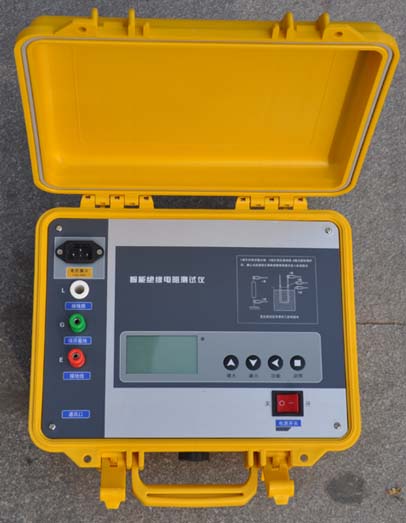
Megohmmeter
Darui Electric recommends:
Working Principle
The Digital Megohmmeter is composed of large and medium scale integrated circuits. This instrument features high output power, high short-circuit current values, and multiple output voltage levels (four voltage levels). Its working principle: DC voltage generated by the internal battery power supply through DC/DC conversion is output from the E terminal through the test object to the L terminal, generating a current from E to L. After I/V conversion and divider calculation, the measured insulation resistance value is directly displayed on the LCD.
Features
1. High output power, strong load capacity, and strong anti-interference capability.
2. The housing is made of high-strength aluminum alloy, with built-in equipotential protection ring and 4th-order active low-pass filter, effectively shielding against external power frequency and strong electromagnetic fields. For capacitive test objects, the output short-circuit current exceeds 1.6mA, making it easy to rapidly raise the test voltage to the rated output value. For low resistance measurements, the proportional method design ensures that voltage drop does not affect measurement accuracy.
3. No manual cranking required — battery powered with automatic range conversion. Clear panel operation and LCD display make measurement very convenient and fast.
4. Output short-circuit current can be directly measured without estimation through load measurement.
Synthetic Resistance
The synthetic resistance method is excluded due to design cost and size constraints. Instead, a discrete high-voltage resistor matrix approach is adopted, forming an array capable of providing over 500,000 resistance value outputs. In this calibrator, there are 8 resistance ranges covering 10 kΩ to 10 GΩ, with each range providing 4.5-digit stable output.
Integrating suitable high-voltage resistors into a single instrument presents another challenge — the safety standard associated with the EU CE certification mandatory requirement, the Low Voltage Directive. The standard relevant to instrument manufacturers is EN 61010 — Safety requirements for electrical equipment for measurement, control, and laboratory use.
The Low Voltage Directive requires calibrator voltage to be limited to 1,000 Vrms. So how to calibrate megohmmeters with test voltages up to 5 kV? Such instruments have a wider dynamic range, can measure resistance up to 10 TΩ, and provide the guard terminal described above, enabling accurate measurement of very high resistance values. Fortunately, such a guard configuration can itself form a resistance multiplier, effectively multiplying a known resistance by a factor of 1000. Equally important, since the multiplier is a discrete, isolated, independent device that meets the high voltage requirements of the multiplier, it falls outside the scope of the Low Voltage Directive.
How to Select
The voltage rating of the megohmmeter should be higher than the insulation voltage rating of the object under test. Therefore: when measuring the insulation resistance of equipment or lines with rated voltage below 500V, a 500V or 1000V megohmmeter may be used; when measuring the insulation resistance of equipment or lines with rated voltage above 500V, a 1000~2500V megohmmeter should be used; when measuring insulators, a 2500~5000V megohmmeter should be selected. Generally, for measuring the insulation resistance of low-voltage electrical equipment, a 0~200MΩ range megohmmeter can be selected.
Note: The above information and technical parameters are provided by Yangzhou Darui Electric Co., Ltd.